
Case Study
Corporate Report Partner
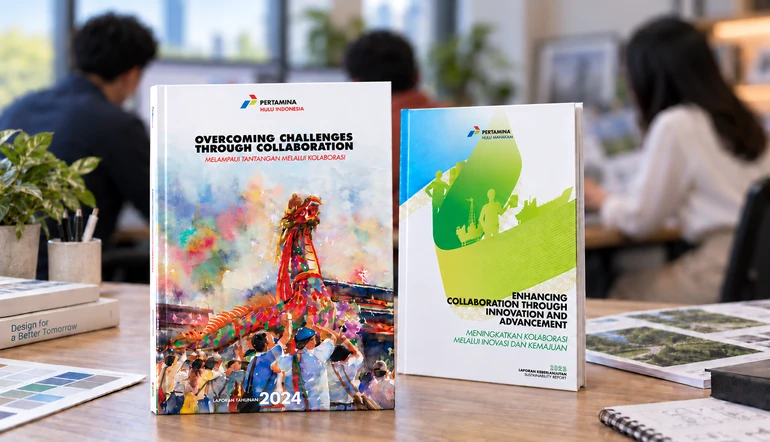
Crafting Meaningful Annual Report Themes
As a key pillar of the national energy industry, PT Pertamina Hulu Indonesia (PHI) recognizes the critical importance of strategic communication. Formulating concepts and titles for both the Annual Report and Sustainability Report is no overnight task; it requires precise thinking, data mastery, and a sharp linguistic intuition. So, what actually happens behind the editorial desk of PHI’s report preparation team? Here is a breakdown of the crucial steps in crafting a solid, elegant, and relevant corporate report theme.
Comprehensive Investigation and Research The team does not merely look at profit and loss statements; they conduct an internal investigation into PHI’s operational track record over the past year. This process involves sifting through upstream oil and gas production data, tracking media sentiment, and evaluating Corporate Social Responsibility (CSR) programs. Fundamental questions guide the research: What were PHI’s major milestones this past year? Were there new technological innovations in field operations? How have the company's programs progressed? This research forms a solid foundation, ensuring the narrative remains rooted in field facts rather than unverified claims.
Unearthing Insights Once the data and news are compiled, the team shifts to information extraction. This is where intensive brainstorming takes place. Various perspectives are brought to the table to uncover key insights. Copywriters analyze key phenomena—for instance, discovering that despite global crude oil price fluctuations and mature fields, PHI successfully maintained productivity through innovative programs. They also address complex challenges, such as impairment factors experienced by the company.
Curating Insights Not every insight is suitable as a main theme. The gathered insights must be tested for their relevance to PHI’s actual conditions. The chosen theme must capture both the current landscape and challenges faced by PHI, while demonstrating the company’s resilience in overcoming them. This filtering process ensures the message is not only well-crafted, but also contextual and impactful. Hunting for Keywords Once the narrative direction is agreed upon, the team shifts to linguistic formulation. Selected insights are broken down to identify the most compelling keywords. For modern audiences, the chosen language must be dynamic, forward-looking, and reflective of integrity. Keyword selection is crucial as it sets the tone for the entire report—whether the company aims to convey optimism, prudence, or aggressive innovation for the year.
Drafting a Captivating Title Armed with refined keywords, the team begins crafting titles—the intersection where business logic meets linguistic aesthetics. Following journalistic standards, a title must be concise, direct, and unambiguous, yet still carry an emotional hook. This phase often takes time, producing numerous title iterations. The team evaluates which phrases sound natural, look elegant on the cover, and most accurately summarize hundreds of report pages into a single cohesive sentence.
Proposing Concepts to Corporate Management The final stage involves presenting the proposals to the Person in Charge (PIC) and management team at PT Pertamina Hulu Indonesia. Proposing titles is not simply presenting a list of options; it is presenting a communication strategy. The team must provide clear rationale behind every word choice, explaining why Title A best represents the financial strategy for the Annual Report, or why Title B is the ideal fit for a Sustainability Report focused on Environmental, Social, and Governance (ESG) criteria. Constructive dialogue with management leads to the final, solid decision.
Ultimately, preparing the Annual Report and Sustainability Report for an entity as large as PT Pertamina Hulu Indonesia is the art of storytelling. Through these multi-layered steps, the company does not merely satisfy regulatory obligations—it actively nurtures public trust, proving that every step taken today is an investment in a better future for Indonesia's energy sector.
back
